 Life with a Keeshond is never dull. They are busy, active little people, measuring 17 inches (43 cms) and 18 inches (45 cms) at the shoulder for a bitch and a dog, respectively. They are real family dogs and like to be part of your life and whatever you are doing. They are marvellous with children, and many a toddler has learnt to walk clutching a handful of a Keeshond coat.
Keeshonds are very versatile, extremely adaptable and highly intelligent – often too much so! They are good travellers and love cars; in fact, they almost insist on a permanent seat in the car. They can be trained for any of the disciplines, such as agility, heelwork to music or obedience. They require regular exercise, but not excessive amounts, although they are quite happy to do a five-mile hike if required!
Keeshonds generally give their special allegiance to one particular member of the family, and this is of their own choice, not necessarily the person who feeds them or exercises them the most, either. They can be stubborn at times, but this can usually be resolved with a little persuasion and a small reward. They are excellent watchdogs and will alert their owners to any unusual sounds. They are, unfortunately, rather fond of the sound of their own voices, and this trait has to be firmly trained from a young age.
One of the big loves in a Keeshond’s life is food. They are not fussy eaters and will eat most modern dry foods with a little “something” extra sprinkled on the top, just to ring the changes. Weighing in at about 35 lbs (15.5 kg) and 40 lbs (18 kg) for a bitch and dog, respectively, they only require moderate amounts of food to keep them happy – that won’t make great inroads into the housekeeping budget.
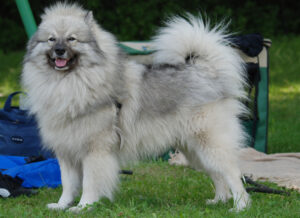
Keeshonds only come in one colour. Their body coats are of shades of grey, from silver grey to wolf grey, with cream legs and feet. Their faces are triangular in shape, being a little wider across the cheeks, extending to a longer muzzle, with a slight rise to the skull, finishing with neat pricked ears giving an alert but gentle expression. They should have dark almond-shaped eyes, black noses and well-defined ‘spectacles’ shown as a delicately pencilled black line slanting from the outer corner of the eye to the lower corner of the ear, coupled with distinct marking and shading forming expressive short eyebrows.
They have a double coat with a soft, more creamy undercoat and an outer coat of dark guard hairs, which is harsher and more off-stand. The length of the coat should not be excessively long and flowing, a shorter and harsher coat being the correct type, as it would have been in the days of their forefathers when they travelled on the Dutch barges guarding the cargo. A grooming session of about an hour once a week should keep them in good order, with claws trimmed regularly.
The breed in general has a good life span with a life expectancy of an active 10-12 years of age. Health problems have been dealt with to a large extent, and primary hyperparathyroidism is now tested for and almost completely eradicated.
This file is licensed under the Creative Commons Attribution-Share Alike 3.0 Unported license. Attribution: I, Lilly M